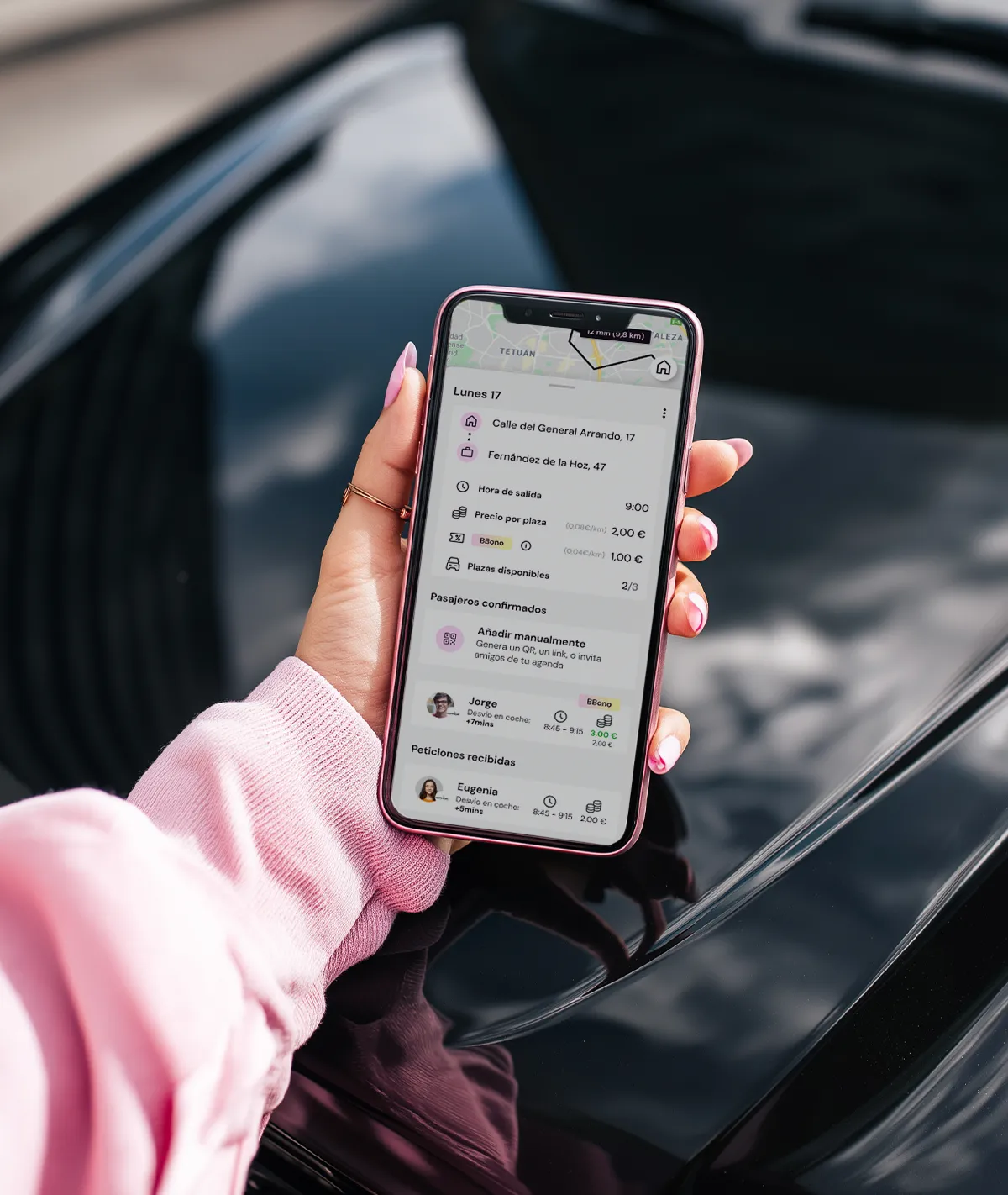
Tribbu, the website that offers money for sharing your daily trip

Carpooling for work or college should be a way to earn money. This is what they think in Tribbu, the rideshare service that follows the French model BlaBlaCar but focused on routine trips. The business was born six years ago as Hoop Carpool and served only companies: it connected its employees to share a car on the way to the office with incentives for drivers. This was the case until it opened to the general public in June and, in September, it was renamed Tribbu (the service offices still have plaques and carpets with the old name). The results of the expansion of the business have been positive: at the end of September, the half million in sales in 2024 more than doubled and the number of frequent users has increased by two, to 6,000 (the total number of registered accounts, including those of those who barely use the application, reaches 60,000).
“We were slow to understand what we wanted to be,” says Paloma Martín, its 32-year-old co-founder and CEO. What Tribbu seeks to expand its number of users is to take advantage of new incentives for sustainable businesses: starting at the end of 2023, Ecological Transition enables to polluting companies offset their emissions by investing in energy efficiency initiatives, such as carpooling (the former hitchhiking or, in English, Carpooling). These funds represent more than half of Tribbu's turnover, which it distributes it in part to its users, as required by regulations. The application pays one euro per passenger driven for every 25 kilometers traveled.
70% of Tribbu's users are in Spain, especially in Madrid and the Basque Country, which have local aid From promotion to Carpooling, but also in Andalusia and Extremadura. Another 20% in Mexico and the rest, between Colombia and Portugal. Tribbu closed September with 46,000 monthly trips, compared to less than 20,000 on average when it served only companies. On average, it takes 30 minutes for a user to find a car buddy. The company's main challenge today is to reduce that waiting time and monitor live trips, says Carlos Alonso, chief technology officer and co-founder of Tribbu. To this end, the company, which has 25 employees, invests half of what it enters in technology.
Tribbu does not yet expect to generate profits, but its founders believe that it has already overcome the most adverse circumstances. “It's an industry that has yet to be built,” emphasizes the CEO next to her Golden Retriever more than 10 years old. It all started by chance. Martín, an advertiser from Salamanca, and her partner Nathan Lehoucq had been trying to devise a platform for routine trips such as going to work for months in 2018, but they lacked a technical profile that could create the application. In the middle of that year, they met Alonso, an engineer from Madrid, in the capital, through friends. “It was just what we lacked,” Martín affectionately evokes. Later, the three were joined by a fourth young entrepreneur: Andrea García.
The four co-founders had been developing a pilot project together for just one year for the employees of the company Iberia and the students of the Alfonso X University when the pandemic hit. “We had to juggle to keep investing in technology,” Martín recalls, referring to the six months in which their salaries had to be taken away. The business resisted. They signed 20 new agreements in 2020 with large companies such as Telefónica, and in 2021 they received the support of Juan Roig's accelerator. Since the beginning, Tribbu has raised about four million in three rounds of private funding, half in the last one, held on October 6 and in which Iberdrola led with one million euros invested.